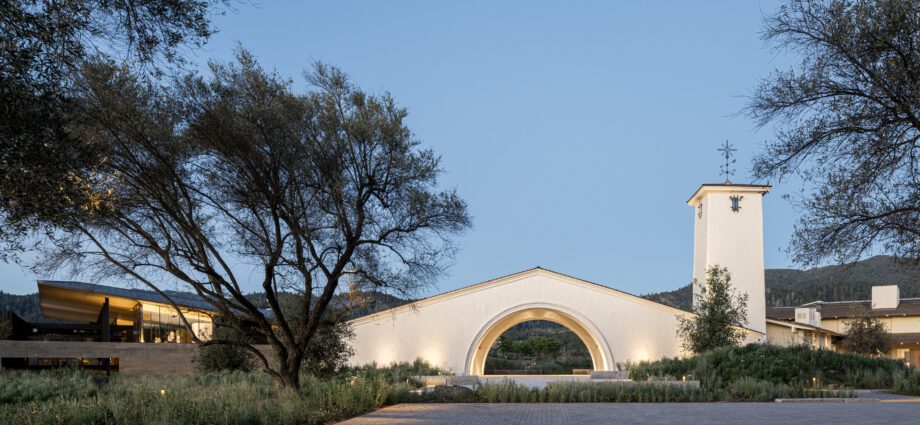
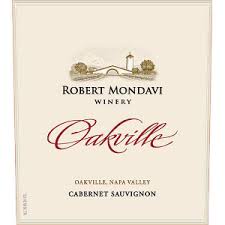
OAKVILLE, Calif. – For its 60th anniversary, the Robert Mondavi Winery has restored its Cliff May-designed visitor building and relandscaped the grounds, bringing renewed attention to one of the most recognizable pieces of architecture in American wine. The historic building and its signature tower—long featured on the winery’s labels—remain central to the brand’s identity.
“This transformation reflects a renewal of Robert Mondavi’s original vision,” said Peggy Hemphill, Brand Marketing Director for Robert Mondavi Winery, in a press release.
The reopening follows a three-year overhaul that includes a new visitor and hospitality wing, expanded tasting areas, and updated winemaking facilities. The touchstone remains 1966, when the winery opened and helped usher in the modern era of Napa Valley wine tourism.
Cliff May (1909–1989) is best known for popularizing the California ranch house, but his commercial work played a quieter, equally important role in shaping the state’s brand of architecture. Rather than embrace strict modernism, May worked in a regional idiom—blending Spanish Mission influences, indoor-outdoor living, and a relaxed, site-responsive approach that mirrored California’s emerging lifestyle identity.
The Los Angeles Conservancy has noted that May “fused elements of the Spanish Revival style with Modernism” to create buildings defined by low profiles, open plans, and an emphasis on outdoor living—an approach that translated seamlessly from suburban houses to experiential commercial spaces.
Working with partner Chris Choate, May also developed projects like Lakewood Rancho Estates in Long Beach, extending his vision at scale.
At the Robert Mondavi Winery, that philosophy found one of its clearest commercial expressions. May combined mission-style forms with modern construction and mid-century restraint to create not just a production facility, but a destination. When it opened in 1966, the winery helped redefine what a winery could be—less an industrial site and more a curated visitor experience—setting a template for Napa Valley’s future.
The recent restoration reinforces that legacy. May’s arch and tower have been carefully preserved, while new additions by Aidlin Darling Design and Surfacedesign extend the campus in a way that aligns with contemporary expectations.
The redesign restores May’s original intent while opening the estate more fully to its surroundings. A new inverted gable canopy, referencing the winery’s iconic arch, anchors a sequence of indoor-outdoor tasting spaces, terraces, and gathering areas oriented toward vineyard views. A new culinary building with an indoor-outdoor veranda expands the winery’s food and wine program, drawing from on-site gardens. A linear water feature inspired by agricultural aqueducts runs through the south wing, tying the design to both sustainability goals and the region’s farming heritage.
“It’s hard to overstate the impact of Robert Mondavi’s partnership with Clifford May—a meeting of two pioneering minds that produced one of California’s defining midcentury landmarks,” said David Darling, co-founder of Aidlin Darling Design, in the news release. “Our work carries that spirit forward, using design to strengthen the winery’s connection to its site while shaping its future.”
Beyond architecture, the update reflects broader shifts in the brand itself. The winery is pursuing new organic certification for its vineyards and incorporating updated bottling technology under head winemaker Kurtis Ogasawara.
The Robert Mondavi brand is owned by Constellation Brands. Constellation acquired it in 2004 when it purchased Robert Mondavi Corporation, which had been the original publicly traded company founded by Robert Mondavi. Today, the winery and its associated labels operate as part of Constellation’s premium wine portfolio.
As of Friday, April 17, 2026 Constellation Brands Inc. (NYSE: STZ), the parent company of Robert Mondavi Winery, closed at $162.28 a share, according to market data, reflecting a 1.20% decline on the session as broader markets advanced.
J. Garland Pollard IV is editor/publisher of BrandlandUSA. Since 2006, the website BrandlandUSA.com has chronicled the history and business of America’s great brands.