For more than a century, local radio stations have connected Americans to their communities. They have carried election returns, school closings, weather emergencies, church services, high school football games, obituaries, farm reports, local music, and the daily conversations that define civic life. Yet across the country, many of these stations are quietly disappearing.
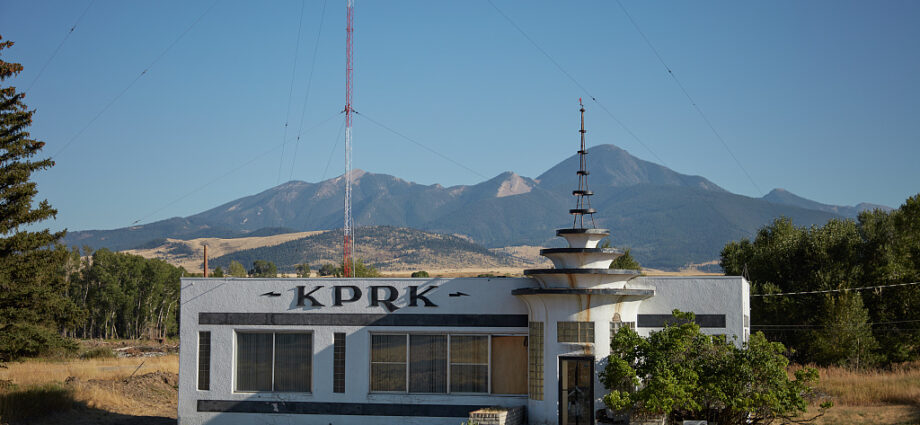
Pictured above, KPRK AM in Livingston, Montana, an old railroad town that became the first gateway city to Yellowstone National Park. While the station has abandoned its historic home, there is an effort to fully restore the station building and put the station back on the air. The group also wants to have an ampitheater and make it a local cultural asset.
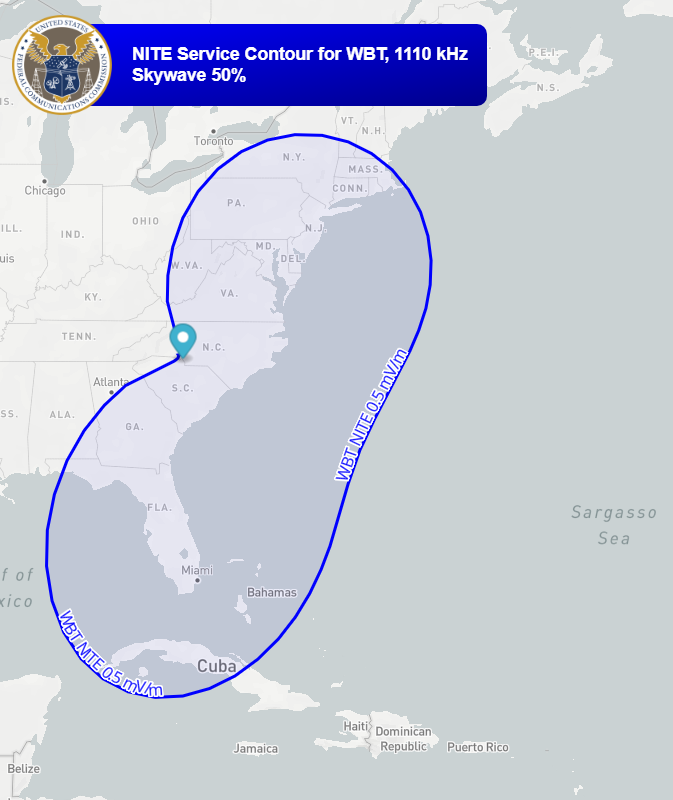
Even with examples like KPRK, many are closing and disappearing. That some have moved to FM is no consolation, because the AM band is still viable for many. Here, the map of WBT AM, which is one of the nation’s clear channel stations, that has a vast audience all evening. Right now, the AM transitter location, itself a historic site, is for sale, with locals hoping for its preservation. It is rightly eligible for the National Register of Historic Places. While that does not protect from destruction, it would bring its cause attention.
Service area of WBT-AM at night, from FCC databases. Many clear channel satations are at risk across the U.S.
When a historic building is threatened, there are often preservation organizations ready to document it, advocate for it, or find a new use. When a local radio station goes dark, however, there is rarely a comparable effort to preserve the public value of the broadcast license, the local service it provided, or the opportunity for future community ownership. WBT is a rare example.
That gap deserves national attention, not only at the FCC, but with agencies and non-profits concerned with culture, historic preservation, emergency response and public access.
On June 20, 2026, I filed comments with the Federal Communications Commission in MB Docket No. 22-459, the Commission’s Quadrennial Review of Broadcast Ownership Rules. Rather than simply opposing further ownership consolidation, I urged the Commission to consider a broader question: should long-serving local broadcast facilities be viewed as communications infrastructure worthy of preservation, much as the nation has developed policies to preserve other important civic assets?
I wrote:
More broadly, I encourage the Commission to consider whether local broadcasting deserves a preservation framework similar in spirit to the policies that have long protected other important community assets. Federal policy recognizes the importance of preserving historic buildings, transportation corridors, and other forms of civic infrastructure. Local radio stations, frequencies, licenses, and broadcast infrastructure (even towers) are also public assets. They represent decades of community service, emergency communications capability, local identity, and civic engagement.
This is not an argument for preserving radio out of nostalgia. Radio has repeatedly adapted to technological change, surviving the arrival of television, FM broadcasting, cable television, satellite radio, and internet streaming. Its enduring strength has never been national scale. It has been local service.
If that premise is still true, then federal policy should ask a different question. Instead of focusing only on how many stations a company may own, should the United States also develop a policy for preserving heritage radio stations and encouraging their transition to new local owners before they disappear altogether?
This article begins a new series exploring that question. In the months ahead, we will document heritage stations that have gone dark, examine successful locally owned broadcasters, explore new technologies that could lower the cost of operating local stations, and consider policy ideas that could help preserve local broadcasting for the next century.
J. Garland Pollard IV is editor/publisher of BrandlandUSA. Since 2006, the website BrandlandUSA.com has chronicled the history and business of America’s great brands.
But can they sell enough advertisements to keep the lights on? Once main streets have become ghost towns with just struggling businesses is there a large enough customer base left to make a go of it?




But can they sell enough advertisements to keep the lights on? Once main streets have become ghost towns with just struggling businesses is there a large enough customer base left to make a go of it?